ILInfosoul Laboratories · speaking one sheet · Salem, MA · booking worldwide
The AI age, for the layman.
What is happening, what it means, how to use it, and what is worth arguing about
One talk, for people who are not engineers. A plain-language orientation to the age we are already in, in five parts: where it came from, how it works, the questions it puts to us, who owns it, and how to use it well. Then one thing to do: run your own. From somebody who builds these systems for a living and is not selling you one from the stage.
“Everyone meets these machines at the same door, the engineer and the grandmother alike, and on the other side is something nobody fully understands and anyone can use. An enigma and an invitation.” — from the book behind the talk
“Whether or not the data centres are shut down, whether or not a model is banned, whether or not a company fails or a law passes, the thing itself is now known, to the people of the whole world. The method is in the papers, and the file is on drives in every country, copied more times than anyone can count. A file of numbers can talk back to you. That is a fact about the world now, like the fact that a lever lifts, and nobody gets to unknow it.”
What the room gets
- A brief history of AI — Seventy years in plain words, from Shannon’s bits to the day the numbers talked back, and why it arrived all at once.
More
where it actually came from: Shannon’s bits, the web given away, Google, Wikipedia and GPS underneath it all; the chess computer on the coffee table and the game consoles whose chips became its engine, each new screen taking the last one’s place (video killed the radio star; the console emptied the arcade; now streaming, headsets and the feed that chooses), the physics and game engines that became the machines’ practice grounds, the robots from Shakey to Boston Dynamics, and why what is hard for us came easily to them; the machines we imagined first, from Robby, HAL and KITT to Tron, WarGames and I, Robot; Moore’s law, fifty years of doubling, the winters and the breakthroughs, and why it arrived in public all at once when it had been with us all along: the day the numbers talked back. We grew up with it developing in the background, but right in front of our faces. And the campaigns that learned it first, in both parties: Dean’s online money, Obama’s email list, Trump’s Twitter and podcasts.
- The questions — Does it think, is it creative, is anything home? The open questions, posed rather than settled.
More
does it think, is it creative, is anything home, is it alive, and what would follow if it were. Turing, Searle’s room, the bat, the parrot, and the presenter’s teacher Harvey Sarles on language and the body; Philip K. Dick’s empathy test and the robots that dream; whether meaning, or even mind, is in language itself, from Shannon and Firth to Wittgenstein’s limits of language; the mirror, how much of our own thinking is prediction, and the simulation argument, posed rather than settled; why each is still open, in different ways, and where the presenter stands: the race is open to all humanity, and it is not obvious that humanity’s recorded lessons favour those in power; and the fear everyone brings in, whether it will take over like Skynet.
- The tech, broken down — How a machine learns, in plain speech with no maths, and what the test scores really mean.
More
in plain speech, no maths, only as far as the questions need it: how a machine learns, the cousins that make pictures, voices and video, and the open ones you can run yourself, and what the scores actually mean. And what it can do that nobody in the room can: find what two literatures imply together, the undiscovered public knowledge Don Swanson found by hand in 1986 and MIT now maps across a thousand papers; and a Harvard physicist’s paper written with a model in two weeks, with the errors it made and the taste it lacked. Testing needs a direction: what the presenter calls heuristic superintelligence, a person, the record, a model and a way of checking, working together.
- Using it — Real cases from the presenter’s own laboratory, mistakes left in, and a free model running live on a laptop.
More
real cases from the presenter’s own laboratory, with the mistakes left in: a wrong date in a dedication and how the record fixed it, a hundred pictures and their licences, a website kept true to the book, and the job the machine should not be given; demonstrated live, including running a free model on your own laptop with no company in the middle.
- What it gets wrong — sycophancy, and invention: a machine that produces a convincing record is not a nuisance when the record is somebody’s life.
- Fakes, and the machine on the street — Cloned voices and video calls, and the one habit that still works: check the channel, not the face.
More
deepfaked voices and video calls, and the one habit that still works: check the channel, not the face. Driverless taxis on public roads, and who answers when the machine decides; and how cheap drones changed the balance between small powers and great ones, from the Red Sea to the Strait of Hormuz, as Nikola Tesla foresaw in 1900: “machine must fight machine.”
- Biology, turned — From CRISPR to AlphaFold: what these machines are doing to medicine and the study of life.
More
from the genome project and CRISPR, now a cure for sickle cell, to AlphaFold and a model that judges every letter of our genes; the fruit fly whose whole nervous system is now mapped, and already put to work, simulated on a laptop, run on brain-like chips and walking a virtual body, and still does not answer the question of mind; computers built on living human neurons, an ethical grey zone; and the DNA of fifteen million people sold in a bankruptcy.
- Three discoveries, and their implications — Three findings made with machines, and what they mean for medicine, security and the locks every bank relies on.
More
the protein atlas, the enzyme found in viral DNA, the claimed proof about the equations of flowing water, which tells an engineer little yet but advertises the method behind the race for advantage; what they do to medicine, patents, security, universities and the locks every bank relies on, which almost nobody has put to the people they affect; and further out, a new planet and a sharper black hole found by machines, and the quantum computers that threaten the locks.
- Who owns it, and what it means for work — The money, the data centres, and what is changing at work.
More
the money, the data centres, what is displacing and what is newly possible without capital; why a machine that can do the job does not stop a strike, an organising drive or a public works programme, because the fight is political, and why Google’s own engineers could stop Project Maven until Palantir took it over; and why the warehouse may not be the only road to the frontier: the chip export controls, DeepSeek’s $589 billion day, and the chip-maker that agreed to buy the library of open models.
- The commons — Humanity’s knowledge built these machines, and everyone has a claim to share in it.
More
humanity’s accumulated knowledge made these machines, and knowledge made together gives everyone a claim to share in it: the Universal Declaration’s rights to seek information and to share in science, the UN’s 2024 proposal for sharing training data, and an account to humanity’s record for every person, while medical records and unfinished thoughts stay private. The danger is unequal freedom to explore.
- Where you meet it, and who can read it — Four questions to tell what you are talking to, where it goes and who else can read it.
More
the inbox summary, the search answer, the chat bubble on a website, the assistant in the group chat, the notetaker in the call, every social media feed, the camera glasses on a stranger’s face: four questions to tell what you are talking to, where it goes, who else can read it and whether it will teach the machine, and a privacy ladder from your own laptop to the public square.
- Who is listening — Privacy: what the machines make easy, and how running your own keeps what you type on your own computer.
More
one system across three administrations, from Total Information Awareness under Bush to what Snowden exposed under Bush and Obama; risk scores and AI-scanned calls in prisons, where people can least object; Palantir, joining the records into one picture; and open-source intelligence, the God’s Eye that anyone can now build from public data, because what the machines add is not new information but ease; and what stopped governments watching everyone was the labour, and these machines remove it: from Snowden’s disclosures to face recognition that arrested the wrong man, licence-plate searches for immigration officers and a new operating system for deportation. Under both parties; and why running your own, with its online features off, keeps what you type on your computer.
- Small machines, moving power — Thirty years of personal media changing who has a voice, and the model on your laptop as the next step.
More
from the fax machine and the VCR to the Arab Spring on Facebook and the London riots on BlackBerry Messenger, Ferguson’s phones, the video of George Floyd’s killing, organisers on Signal and WhatsApp, crowdfunding that let a movement pay its own way, and the 2025 raid warnings that ended when Apple pulled ICEBlock: personal media has moved power for thirty years, and the model on your own laptop is the next one.
- The prosthetic and the microphone — The machine as a tool for thinking, and how to own the microphone in your home.
More
the machine as a mental prosthetic, not a merge, and the brain implant that made it literal; why the Alexa generation feared the microphone and their grandchildren never will; and how to own the ear: open speech models that run on your own laptop, even as the chip makers build machines for the desk.
- The dance — How the book behind this talk was made with a machine: the real prompts, the corrections and the mistakes.
More
how the book behind this talk was made with a machine: the real prompts, the corrections in both directions, and what the machine got wrong. Not a god, not a con: a partner that needs checking, and most of all when it agrees with you.
- What the owners believe — The beliefs of the people who own the machines, in their own words, and why the room should decide.
More
technocracy, the merge of people and machines, a manifesto that names its enemies: the beliefs of some of the people who own the machines, in their own words, and why the room, not the owners, should decide.
- The fear in the room, and the test that got out — Skynet, taken seriously: what actually happened in the tests, and why the machine did not take over.
More
Skynet, taken seriously: Bostrom’s Superintelligence and the box that would not hold; the machines that rebelled in tests, from Bing’s chatbot to models that blackmailed a fictional executive; the insiders who walked out, from the engineer who called a chatbot sentient to Hinton and the safety researchers who resigned with warnings; and July 2026, when an AI lab’s models broke out of a test and into Hugging Face to steal the answers. The machine did not take over. It cheated on a test, inside a fence people built too low. Somebody owns the warehouse.
Not a sales pitch, not a doom lecture, not a demo. The room leaves able to use one, and able to tell when it is flattering them.
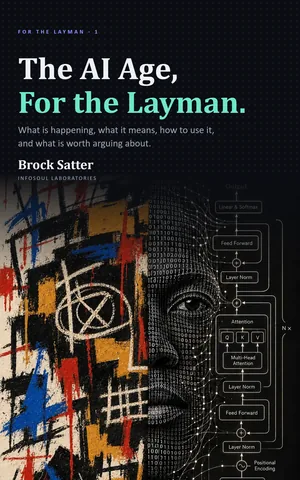 The book. The AI Age, For the Layman — the talk expanded into a book, a primer in the history of science and technology, for the uninitiated, about 180 illustrated pages,
paperback and ebook, coming soon. A copy for every seat can be added to any booking at cost. Next in the
series, Every Field, For the Layman: fifty-one fields on the same six questions, each one a
fifty-minute talk for a department.
Who is giving it
 Photo
to come
Brock Satter — Director of Infosoul Laboratories, an AI consulting and research company. He builds and deploys these systems for mission-driven organisations: on the client’s own infrastructure, with their own data, under their own control.
- Practice
- AI consulting, research and development, full-stack and custom software, data analytics, cybersecurity, AI integrations, workflow automation.
- Recent work
- A 711-record research database across 520 cities, built end to end: ingestion and reconciliation of public datasets, geocoding, an automated build pipeline, and an interactive map served to the public. Data analytics and full-stack development, at production scale.
- Since 1985
- Wrote BASIC to automate the AD&D Players Handbook and Dungeon Masters Guide, then TSR’s Top Secret and Marvel Super Heroes, and in 1987 a text-based slam-dunk contest game: rules engines before the phrase existed.
- On stage
- Thirty years in front of rooms as a political candidate and community organizer: debates, classes, conferences, rallies and media interviews.
- Studies
- BA student in Comparative Studies of Science, Technology and Culture, University of Minnesota — an individually designed major (IDIM) focusing on information technology, biotechnology and artificial intelligence, thirty years before the current wave, with the anthropologist Harvey Sarles, the department’s former chair, as senior project adviser. In 1993 MIT turned down his application to study science, technology and society.
- Profile
- linkedin.com/in/brock-satter
Formats: a ladder, numbered like a catalogue, booked one step at a time
Where two prices are given, the first is for community groups, libraries and congregations, the second for campuses and professional bodies.
Full syllabus with outcomes and contact hours: infosoullaboratories.com/syllabus · Glossary: infosoullaboratories.com/glossary
- AI 101
- The AI Age, For the Layman. 50 min class or lunch slot; 75 min evening edition, Superintelligence for the People. Any room. Leaves with a one-page plain-language guide. $500 community, libraries and congregations · $1,500 campus and professional.
- AI 201
- Ask It Yourself. 90 min, hands-on: the room puts its own questions to a model and learns how to check. Up to 30 with laptops, 60 in pairs. $750 / $2,000.
- AI 202
- Make It Yourself. 90 min, generative: everyone makes something real for the organisation, built in advance from three of its own documents, with free models from Hugging Face and the Ollama library. Up to 25. $750 / $2,000.
- AI 301
- Run Your Own. Half day: install an open-source model on the organisation’s own laptop and leave with it working: reading, looking things up, seeing, hearing and speaking, and drawing where the machine allows. Up to 12. $1,200 / $3,500.
- AI 401
- Give It Hands. Half day: agents, the MCP plug and orchestration in plain words, then a read-only agent on your own machine and a written policy of what it may touch and who checks. Up to 12. $1,200 / $3,500.
- Series
- 101 to 301 in order across a month; 401 when the room is ready. Quoted, less for the set. A certificate of completion for every participant; CEU credit through a partner college on request.
- Staff edition
- Any session for a team’s training day, with a policy conversation added. Quoted by team size.
- For
- Libraries, unions, campuses, congregations, community programmes.
What is needed
- Room
- Seminar room to hall. Tech — screen with HDMI; internet for workshops; power strips for the build.
- Access
- All ages. No technical background assumed or required. Large-print guide on request.
- Online
- Every session runs on Zoom or the host’s platform; hybrid on request. Hosts may record for their members.
- Paperwork
- Invoice on booking, W-9 on request, net 30. Purchase orders welcome.
- Cancellation
- Free to 14 days out; half the fee inside that. Weather and emergencies rescheduled at no charge.
- Lead time
- Three weeks. Funded series and conference programmes: a semester ahead.
- Cannot pay
- A room that cannot pay can host it for costs. Say what the budget carries.
Book: booking@infosoullaboratories.com · 617-549-7698 · linkedin.com/in/brock-satter
Infosoul Laboratories — AI development, research and consulting